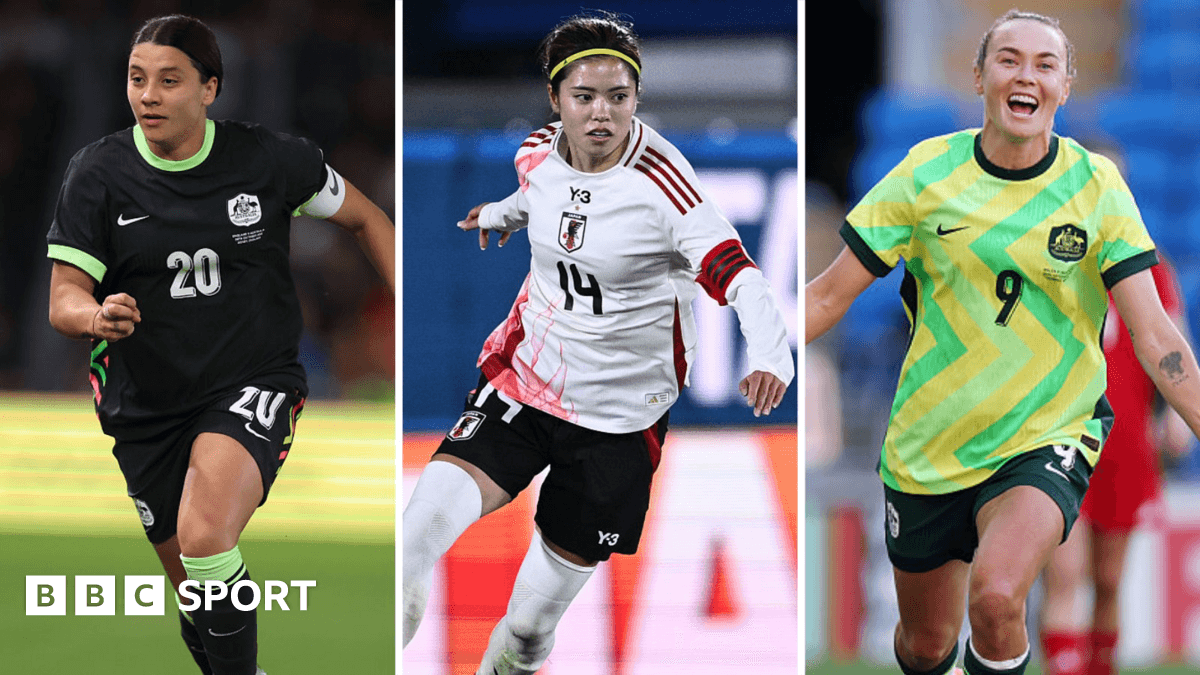
When the Women's Super League resumes on 15 March after a month-long break, there will be several absences among the usual A-list cast.
Published February 26, 2026 • Source: https://www.bbc.com/sport/football/articles/cr5l3qlz4reo
When the Women's Super League resumes on 15 March after a month-long break, there will be several absences among the usual A-list cast.
That is because some of the WSL's biggest stars will be in Australia representing their national teams at the 2026 AFC Women's Asian Cup.
Starting on Sunday, the biggest powers in Asian football will go head-to-head for the right to be crowned queens of the continent on 21 March.
With every WSL side represented at the tournament by at least one player, fans and clubs will be keeping a close eye on how it progresses.
Here's everything you need to know about the tournament and which of your club's players are involved.
What is the Asian Cup and how does it work?
This will be the 21st edition of the quadrennial tournament, which is the biggest international women's football competition for nations in the Asian Football Confederation.
The tournament will begin on Sunday, 1 March with a group stage consisting of three groups of four teams. Members of the same group will face each other in a round-robin format until they have played three matches each.
The winners and runners-up of each group will progress to the quarter-finals, and will be joined by the two best third-place finishers.
The quarter-finals will take place on 13-15 March and the semi-finals on 17-18 March.
Sydney's Stadium Australia - the scene of England's defeat by Spain in the 2023 Fifa Women's World Cup final - will host the final on Saturday, 21 March.
The four semi-finalists will secure automatic qualification for the 2027 Women's World Cup in Brazil next summer.
The four losers at the quarter-final stage will enter the World Cup inter-continental play-offs.
The groups are:
Group A: Australia, South Korea, Iran, Philippines
Group B: North Korea, China, Bangladesh, Pakistan
Group C: Japan, Vietnam, India, Chinese Taipei
Which WSL players have been called up, and which club is most affected?
Twenty eight players spanning every club in the WSL will be at the Asian Cup, though they all play for either Australia (12) or Japan (16).
Any player whose nation reaches the final will miss matchdays 17 and 18 of the WSL season.
The final is also scheduled two days before the first leg of the last eight in the Women's Champions League for Arsenal, Chelsea and Manchester United.
Given the strength of both Australia and Japan, it is highly likely the players listed below will not be available for their clubs at a crucial stage in the season.
Some have proactively taken steps to counter this, with Manchester City moving in January for US star Sam Coffey to bolster their midfield in the absence of Yui Hasegawa.
"It's definitely a tough one," former Scotland and Arsenal defender Jen Beattie said on the Women's Football Weekly podcast. "The travel is pretty insane and even when the players come back they will take a few days to re-calibrate.
"But it is part of football. Clubs that sign these players know they will be missed when called up so have plans in place."
Australia: Steph Catley, Kyra Cooney-Cross, Caitlin Foord (Arsenal), Charlize Rule (Brighton & Hove Albion), Ellie Carpenter, Sam Kerr (Chelsea), Clare Wheeler (Everton), Emily van Egmond (Leicester), Alanna Kennedy (London City Lionesses), Mary Fowler (Manchester City), Clare Hunt (Tottenham Hotspur), Katrina Gorry (West Ham).
Japan: Maya Hijikata (Aston Villa), Moeka Minami, Kiko Seike (Brighton & Hove Albion), Honoka Hayashi, Rion Ishikawa, Hikaru Kitagawa (Everton), Fuka Nagano, Risa Shimizu (Liverpool), Saki Kumagai (London City Lionesses), Aoba Fujino, Yui Hasegawa, Ayaka Yamashita (Manchester City), Hinata Miyazawa (Manchester United), Maika Hamano, Toko Koga (Tottenham Hotspur), Riko Ueki (West Ham).
Who are the favourites?
As the highest-placed Asian side in the Fifa world rankings (eighth) and winners of two of the past three Asian Cups, Japan are joint-favourites to win the tournament.
Hosts Australia are also heavily fancied, though they have not won the competition since 2010. The Matildas suffered 1-0 defeats by Japan in consecutive finals in 2014 and 2018.
Though China's victory in India in 2022 was unexpected, they are the most successful side in the competition's history (nine titles) and should never be underestimated.
North Korea are another traditional powerhouse having won the competition three times (2001, 2003, 2008), but will be competing in their first major tournament since the 2011 World Cup.
They were banned from the 2014 Asian Cup and 2015 World Cup following a doping scandal, before failing to qualify for the 2018 Asian Cup and 2019 World Cup.
The country's strict Covid-19 restrictions saw the team withdraw from the 2022 Asian Cup and 2023 World Cup.
North Korea returned to action in 2023 by winning silver at the Asian Games, and narrowly missed out on qualifying for the 2024 Olympic Games in Paris.
This article is the latest from BBC Sport's Ask Me Anything team.
Ben Haines, Ellen White and Jen Beattie are back for another season of the Women's Football Weekly podcast. New episodes drop every Tuesday on BBC Sounds, plus find interviews and extra content from the Women's Super League and beyond on the Women's Football Weekly feed