
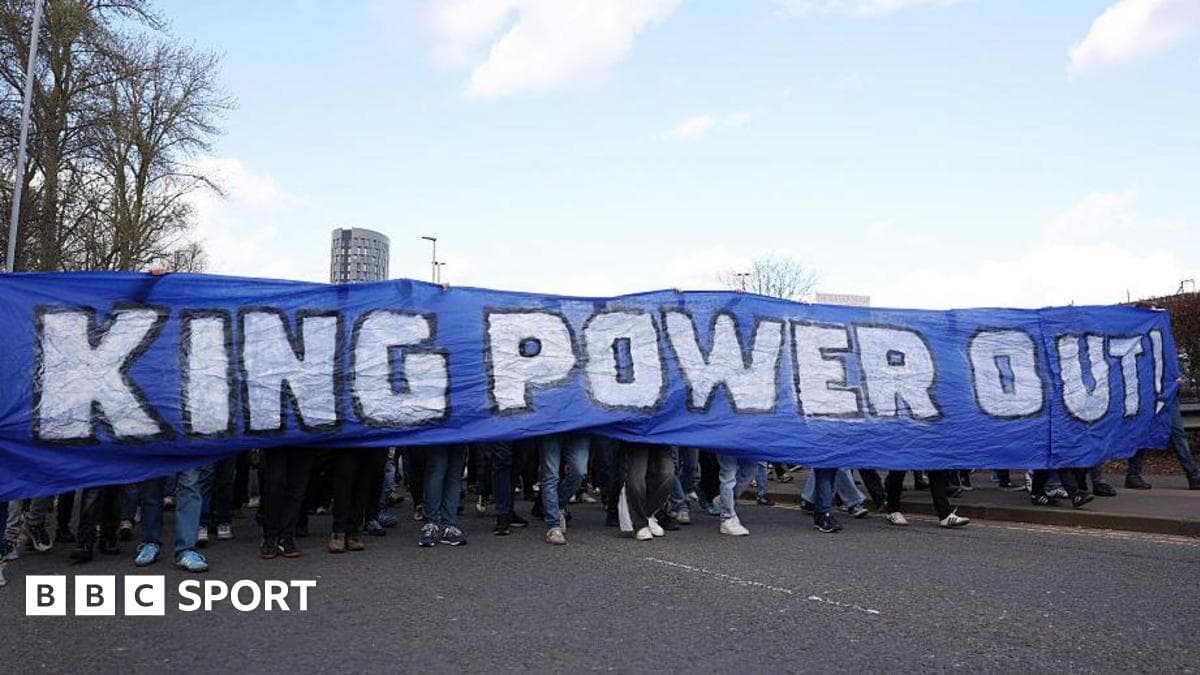
Leicester City fans have been protesting against the club's owners throughout the season
Published April 23, 2026 • Source: bbc.com
By Dale Johnson (https://www.bbc.co.uk/sport/topics/cglgnp4394wt)
Football issues correspondent
Leicester City enjoyed the good times, now they are going to have to endure the bad - and there are signs they may not have hit rock bottom.
The drop to League One was confirmed after Tuesday's 2-2 draw at home to Hull City.
Many fans stayed away from the King Power Stadium as Leicester become only the fifth club to suffer back-to-back relegations to the third tier.
Those who did turn up made their feelings known to the misfiring squad of highly paid players
Supporters also protested against the owners, with 'King Power Out' banners dotted around the sparsely populated stands.
With much of the club's future income effectively mortgaged off at high interest rates, the owners must finance a rebuild.
But if the noises coming out of Thailand are anything to go by, the King Power Group may not have the resources to do it.
Where do Leicester go from here? Could it get worse before it gets better?
How an Australian investment bank has financed Leicester
From the outside it might seem difficult to understand quite how the Foxes got here.
Leicester have been relegated despite having several of the highest-paid players in the Championship.
Even the six-point deduction for failing financial rules in 2023-24 may not mathematically send them down, after just two wins from 19 league games in 2026.
Just last month Leicester reported a deficit of £71.1m for the 2024-25 season, when they were last in the Premier League. There is no indication of another potential points penalty for this period.
Accumulated losses since 2019 have reached £375m, and in recent years future finances have been cashed in to keep the club running.
Loans worth at least £100m have been taken out with Macquarie, an Australian investment bank, at rates of about 8% to 9%.
This includes advanced payments for future transfer fees due on five occasions.
The latest, taken out in September, effectively brought forward instalments due for last summer's sales of Tom Cannon, Kasey McAteer and James Justin.
In January, Leicester rolled over their parachute payment loan, folding in the final tranche of £35m due for the 2026-27 season.
Lots of English clubs use Macquarie in this way, so why could it be such an issue for Leicester?
The club have been using tomorrow's money to pay for today. And if that money tap starts to drip, for instance by being in League One?
"This is going to be the big challenge," football finance expert Kieran Maguire told BBC Sport.
"They will be in receipt of second-year parachute payments, but it looks as if they have already cashed those in through Macquarie.
"They owe transfer fees themselves, because they spent a reasonable amount when they got to the Premier League.
"So there's an awful lot of cash going out, and there doesn't appear to be a lot of cash coming back in.
"And you only get £2m from the League One TV deal."
'Leicester's wage bill is going to be a cause for concern'
Dropping to the third tier within two seasons brings an obvious issue: top-flight wages.
Leicester's wage bill was £150m in the Premier League a year ago, and many of these players remain under contract.
Even if that halves next season to £70m it would be a huge liability.
Some of the big earners - such as Patson Daka and Ricardo Pereira - will be out of contract.
But others will still be at the King Power.
Oliver Skipp is contracted through to 2029. Jannik Vestergaard will be there after being given a three-year deal just before his 31st birthday in 2024.
Harry Winks, who is reportedly on £90,000-a-week, has another year left on his deal after the club's promotion to the Premier League in 2024 triggered an automatic extension.
Finding new clubs for these players will not be easy.
"The average total salary in League One is around about £9.5m," Maguire said.
"Last season, Birmingham's was £38.9m and that was the highest-ever in League One.
"Leicester's wage bill is going to be substantially higher than that, even with relegation clauses, and it is a cause for concern."
New financial rules in League One limit owners to spending 60% of the money they put into the club on squad costs.
That would not stop King Power from funding an attempt to return to the Championship at the first go.
But it would have to add an extra 40% to satisfy these new regulations.
Foxes face stark future if they cannot bounce back
Since the Covid-19 pandemic, the King Power Group - a travel retail group which specialises in duty free shopping - has been through challenging times and last year underwent a restructure.
The troubles of the King Power Group could be linked to the change in the funding model of the football club, and the need to use Macquarie.
But Maguire says there appears to be nothing left to mortgage off.
With the future income already spent or accounted for, the question is who will fund the club?
"This is my concern with Leicester," Maguire said. "Where is the money coming from?
"If it's not going to be the owners, that's where you start to get a little bit twitchy.
"They are just going to have absorb the losses which they will incur in League One.
"I don't see what else they can generate cash from.
"Birmingham lost £34m last season, and the owners were able to ride it out and they got promoted.
"But if you ended up down there for a longer period, then the effects could be more stark."
Somehow, from somewhere, Leicester will need to plug the black hole in the finances and hope they can go straight back up.
"Revenue this year in the Championship would be in the region of £100m," Maguire said.
"If you take into account that they will still get parachute payments, even though they won't keep them, you could probably reduce that figure to around £60m or £70m.
"But they're not going to physically get the £35m parachute payment money, and that leaves a £70 million realistic reduction."
Leicester City have been approached for comment.