
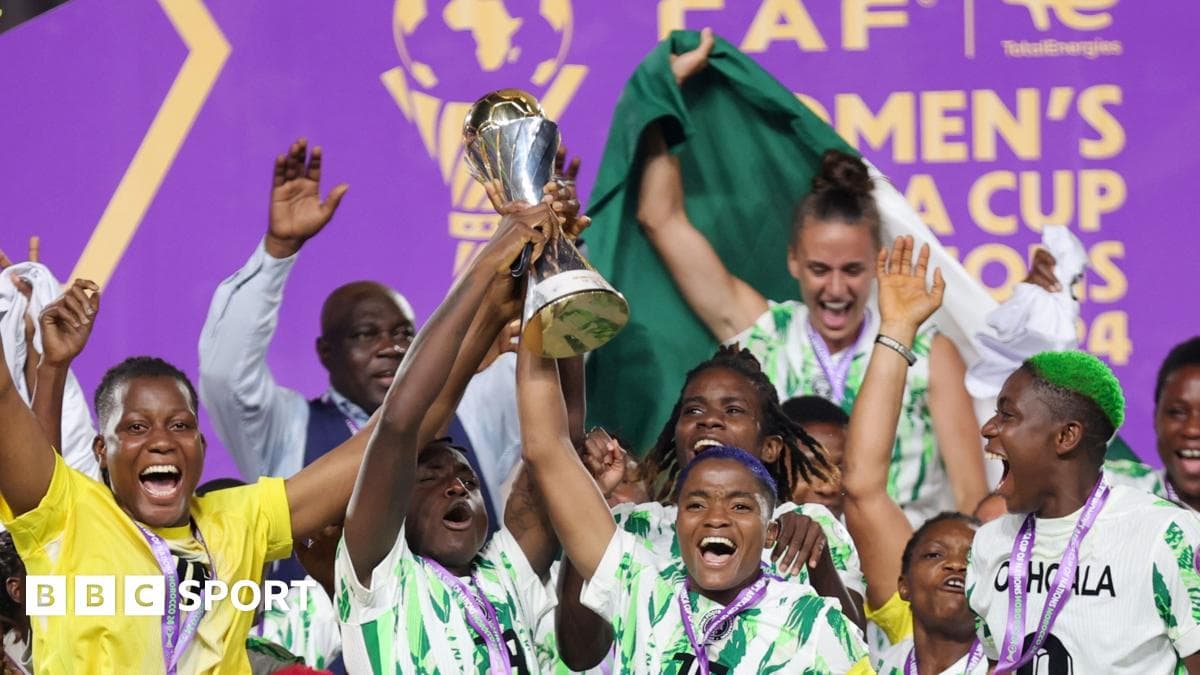
Nigeria are current Wafcon champions after winning a 10th title in Rabat last year
Published March 27, 2026 • Source: bbc.com
By Ian Williams, BBC Sport Africa  and  Celestine Karoney, BBC Sport Africa
Three weeks on from the last-minute postponement of the 2026 Women's Africa Cup of Nations (Wafcon), reasons for the delay remain a mystery, with a senior member of the Moroccan government saying the country was, and is, ready to host "any time".
The tournament was due to kick off on 17 March but is now scheduled to run from 25 July to 16 August.
"That was a decision made at the Confederation of African Football (Caf)," Minister of Industry and Trade Ryad Mezzour told BBC Sport Africa of the postponement.
"What I know is Morocco is always ready to host any competition, any time, and we will be very proud and very happy to host it, be it this month or within three months."
Morocco has turned itself into a de facto home for continental football in recent years.
This will be the third consecutive Wafcon held in the kingdom, while it also hosted the 2022 and 2024 Women's Champions League, last year's Under-17 Africa Cup of Nations (Afcon), the 2023 Under-23 Afcon, futsal Afcons and the recent men's senior Afcon â a tournament which ended in chaos as Senegal walked off the pitch in protest at refereeing decisions made in added time at the end of the final in Rabat.
The West Africans eventually returned to the field of play and claimed a dramatic 1-0 victory over the hosts in extra time - but that result was controversially overturned last week by Caf's independent appeal board following a complaint by the Royal Moroccan Football Federation (FRMF).
Caf's disciplinary committee had initially rejected that appeal, instead deciding to issue sanctions which included a five-match ban for Senegal head coach Pape Thiaw.
When they were announced, the FRMF said those original penalties did not "reflect the seriousness of the incidents", with the Moroccans' ire leading to speculation about the country's willingness to host Wafcon.
While BBC Sport Africa has been told that Morocco's crowded international and domestic football calendar played a role in the postponement, the lack of clarity over the decision has been exacerbated by the brief statement released by Caf which cited "unforeseen circumstances", with "partners, Fifa and other stakeholders" involved in the decision.
BBC Sport Africa was referred back to this statement when it asked Caf to respond to Mezzour's claim that Morocco was ready to host this month.
Politics and player frustrations
At the start of February, South African Sports Minister Gayton McKenzie was forced to clarify remarks from his deputy that South Africa was set to step in as Wafcon hosts, adding further fuel to talk of a potential switch from Morocco.
McKenzie went on to say that "South Africa has expressed its willingness to support Caf if required, should alternative hosting arrangements for the 2026 Wafcon become necessary".
In response, Caf president Patrice Motsepe said "many" other nations were interested in hosting Wafcon but could not because they wanted to alter the dates of the tournament.
Motsepe went on to insist "we can't change the dates" - a comment which has aged poorly, especially as this is not the first time Wafcon has been shunted around Africa's footballing calendar, leading to accusations that women's football is not seen as a priority.
While the men's Afcon was merely delayed by the coronavirus pandemic, Wafcon 2020 was cancelled entirely. The 2024 edition was finally played last July, having been postponed for a year.
This time around, with only 12 days' notice given, teams were in the final stages of their preparations. Ghana's players, for example, were already in a training camp in the UAE.
"It just wouldn't happen for other tournaments in women's football â and especially in men's football," Ashleigh Plumptre told Sportsworld on the BBC World Service.
The Nigeria defender, who was part of the Super Falcons side who secured a record-breaking 10th title last July, says the fact that the 2026 tournament â the first to feature 16 teams â will double up as qualifying for next year's Fifa Women's World Cup in Brazil makes the late postponement more distressing.
"Many teams haven't even been in the Afcon before, never mind had the chance to qualify for a World Cup. It also helps them financially," Plumptre added.
"All I can do, and I've almost probably been forced to be put in this position, is just take day by day and prepare myself in the best way that I can because there's so many things I've had to get accustomed to, and many other players in African football, where you kind of just have to go with it, because you have no other choice."
2030 World Cup planning continues
While Morocco is yet to be officially reconfirmed as the venue for this year's Wafcon, a source close to power brokers at the FRMF told BBC Sport Africa that the Atlas Lionesses do expect to host in July, bidding for a first title after losing in the last two finals, and that Caf would have to officially strip the hosting rights should the governing body wish to make a change.
The uncertainty, however, comes at a time when Morocco is preparing to co-host the 2030 World Cup along with Spain and Portugal.
And although Mezzour admits the Afcon final, which was attended by Fifa president Gianni Infantino, was "difficult", he maintains security forces inside the stadium did a good job.
"We are proud of the way the security corp and the security people did manage this situation," he said.
"We always learn what to deliver from events, be it in Morocco or outside Morocco."
He also revealed that a delegation from the United States, one of this year's World Cup hosts, was in Morocco throughout the tournament.
"The World Cup is a chance for our country, like the Africa Cup [of Nations] was a chance for our country, to create more development, to create more wealth, to create more jobs, to create more public services in healthcare and in transportation. This is very important for us."